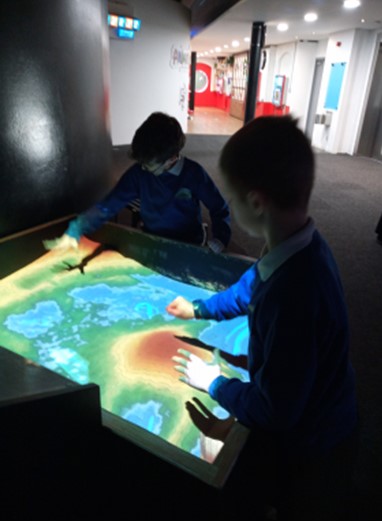


On Tuesday 3rd February, Class 5 and 6 spent a wonderful day at We The Curious in Bristol. Here are some of the pupils’ favourite things:
“The moment that stayed with me most was visiting the large dome shaped planetarium. We were handed 3D glasses to put on as we entered and we sat in comfy seats. When the lights went off it was pitch black. At first, the huge screen showed stars and planets and it was mesmerising. But, within seconds, the dome started spinning and we all felt dizzy and this helped me understand that the solar system is not still!” by Seren, Class 5


We entered We The Curious and headed straight upstairs to the wonky house. The wonky house is a room attached to a confined, narrow hallway and made some of us feel a bit disorientated. Once you stepped inside the room, you immediately reached for the handrail as the house was sloping! The bookcase contained books, but also two optical illusions. Next to it was a fireplace that looked never ending and a mirror that showed you from a different point of view. When we went in to the hallway, there was a hole where the carpet was and if you looked down it felt like you were going to fall—it was an optical illusion! This experience made me think about people’s perspectives and how different people can feel about different things.” by Phoebe, Class 5

When Class 6 arrived at the science museum ‘We The Curious' in Bristol , we had a talk about what we could and couldn’t do. After that, we went to the second floor and there were a lot of cool things, like a smoke tornado. This is where smoke swirls up to an extractor fan light which causes the tornado. There was another exhibit that had a button you pressed to make bubbles appear which pulled a toy boat. There were massive metal hoops and bubble mix in which you could fit your whole torso and head in before they popped. In the planetarium, our topic was moons which included us going into deep space with 3D glasses—which made it feel like we were floating through space! We visited Pluto’s five moons, an asteroid called Ida (in the asteroid belt) which has a small moon called Dactyl. We also learnt that Jupiter has 95 moons and Saturn has 274 moons! On the first floor, there were many different experiments. My favourite one was the hamster wheel that made a waterfall gush rapidly. There was another one where a tennis ball and a parachute had a magnet connecting it to a rope, when it hit the roof the parachute spread out and you had to try and catch it. Thank you to Mrs Smith and Mr Coupe for organising such a fantastic science day out!" by Rory, Class 6
.jpg)
.jpg)

.png)
.png)
.jpg)